
The Tariff Refund Is Real. So Is the Tax Bill.

For a lot of business owners, the past eighteen months of trade policy showed up as a line item. Duties paid at the border, absorbed into margin or passed along to customers, and then largely forgotten because there was nothing to be done about them.
Now some of that money is coming back. And it tends to arrive the same week the headlines are loudest about a $40 trillion national debt and rising borrowing costs.
Those two things feel connected. Only one of them actually asks anything of you.
What happened
On February 20, 2026, the Supreme Court ruled 6-3 in Learning Resources, Inc. v. Trump that the International Emergency Economic Powers Act does not give the President authority to impose tariffs. The Court did not address refunds. That question went back down to the Court of International Trade, which ordered U.S. Customs and Border Protection to refund the duties collected. CBP has been building the systems to process them since.
Refunds are now well underway. According to CBP, roughly $129 billion in refund claims have been accepted for processing. Treasury data shows that in June, refunds paid out exceeded new tariff collections by a wide margin, with $49.2 billion returned against $23.6 billion collected.
Two things are worth noting before anyone treats this as a return to 2019.
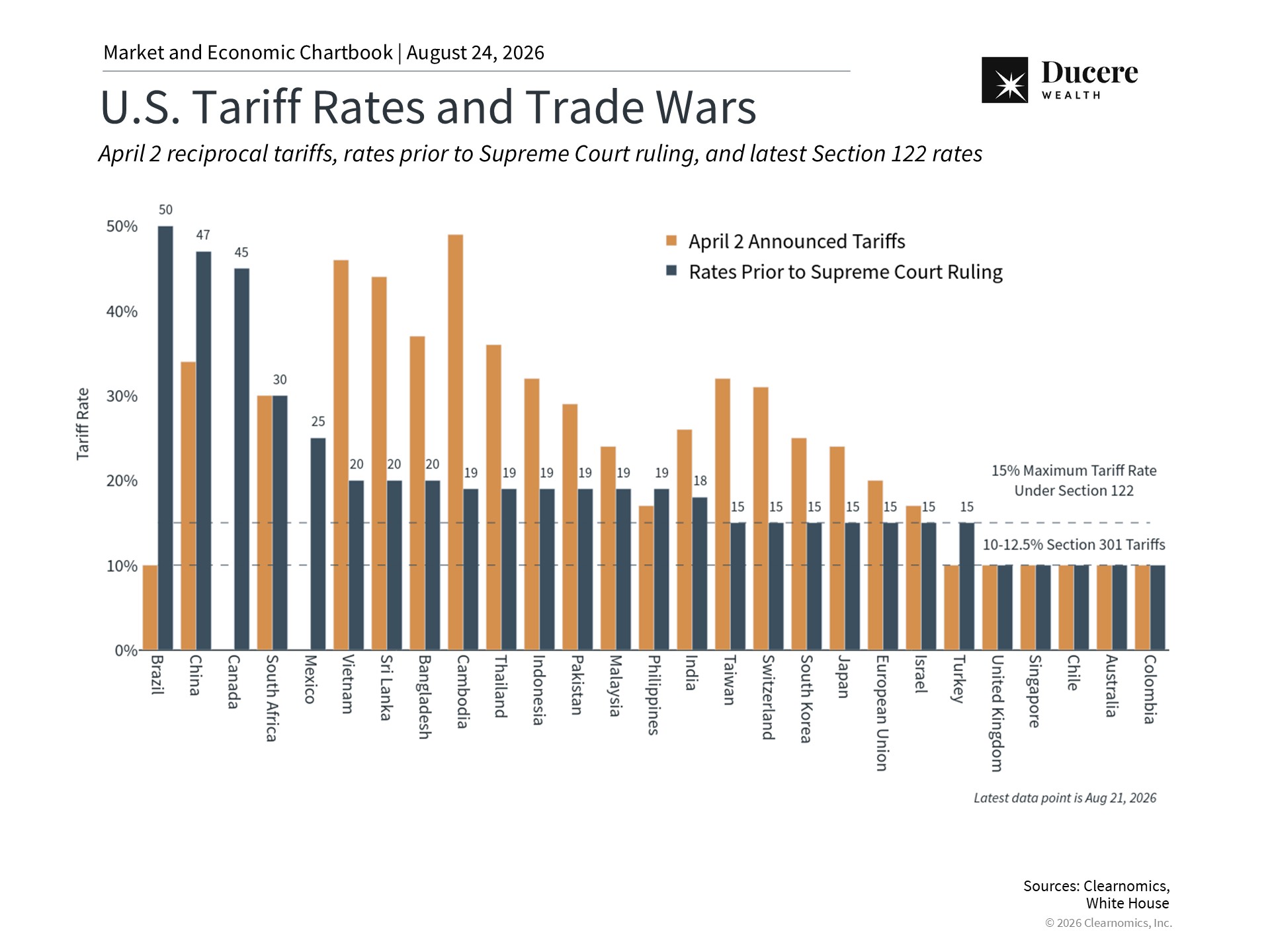
Tariffs did not go away. They were rebuilt on different legal footing: a 15% ceiling under Section 122, plus existing Section 301 duties in the 10 to 12.5% range. For most trading partners, the effective rate is lower than what was announced in April 2025 but higher than what came before it.
And a refund is not a windfall. It is your own money coming back, roughly a year late.
The part that gets missed
Here is where a macro story becomes a planning story.
If your business deducted those duties, either through cost of goods sold or as a deductible expense, the refund is generally treated as taxable income in the year you receive it. This is the tax benefit rule under IRC §111: when you recover something you already wrote off, the recovery goes back into income to the extent the original deduction reduced your tax.
The refunds also carry statutory interest under 19 U.S.C. §1505, accruing from the date the duties were paid. That interest is generally taxable as ordinary income, and on a multi-year claim it isn’t trivial.
The result is a timing problem more than a tax problem. Cash lands in one period. The liability attached to it may land in another. If the duties were capitalized into inventory that hasn’t sold yet, the answer changes again.
None of that is a reason to be unhappy about getting the money. It is a reason to know the number before the year closes rather than in April. For many owners, the practical questions are whether estimated payments need to move, whether the additional income pushes into a different bracket, and whether this is the year a charitable strategy or a deferral does more work than usual.
The specific answer depends on how the duties were originally recorded, and that is a conversation for your CPA. Our role is usually making sure the tax answer and the portfolio answer are being made by people who are talking to each other.
What it isn’t
There’s a temptation to read the refunds as stimulus. Money moves from the government to businesses, balance sheets improve, spending follows.
We’d be careful with that. The cash was already the company’s. Reversing a cost is not the same as earning a return, and a one-time recovery doesn’t change the underlying economics of a business. Some of it won’t stay with the importer at all. Shipping companies have started returning tariff surcharges to the customers who paid them, and some large retailers have said they’ll pass savings through in pricing rather than cash.
For a portfolio, this is closer to noise than signal.
The deficit, in the right frame
The refunds do have a fiscal cost, and it lands on a deficit that was already large. The current fiscal year deficit stands near $1.8 trillion with the year not yet closed, and the Congressional Budget Office’s July projection put the full-year figure around $2.1 trillion. Total federal debt has passed $40 trillion for the first time.
Those are real numbers, and we don’t think they should be waved away. We also don’t think they’re new.
Since 1970, the federal government has run a deficit in every year but four. The only surpluses were fiscal 1998 through 2001. Measure it against GDP, which is a more useful lens than the dollar total since the economy grew alongside the debt, and the 2025 deficit ran near 6% against a long-run average closer to 4%. Worse than typical. Nowhere near 2020’s 14%, or the 20%+ readings of the war years.
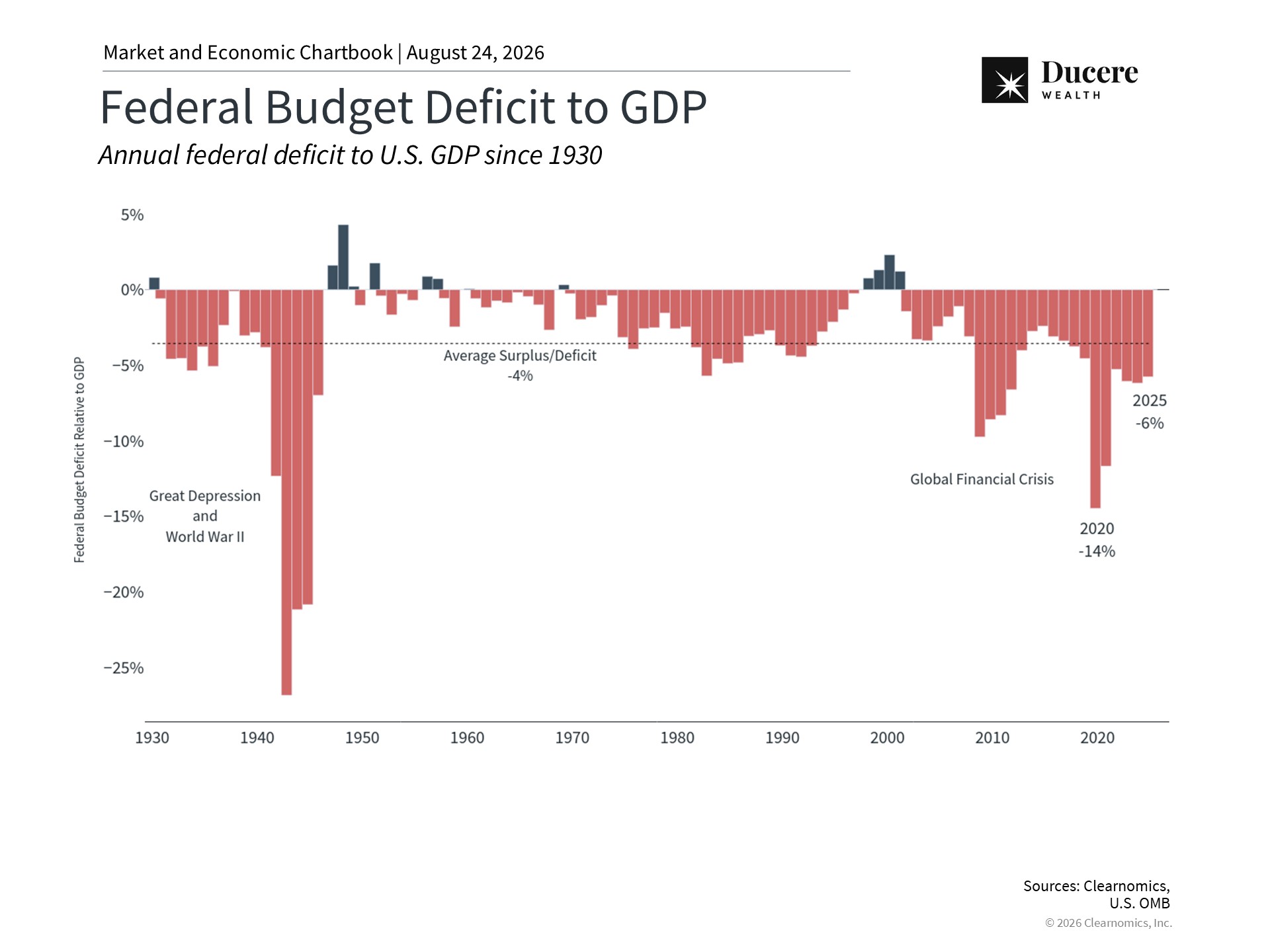
The pattern that’s easy to miss: deficits are usually widest when the economy is weakest, because that’s when tax receipts fall and spending rises. Which means the deficit is often at its most alarming precisely when conditions are turning. It has not historically worked as a market-timing input, and we don’t use it as one.
It’s also worth being honest about what tariffs could ever have done here. Even at their peak, tariff revenue was a rounding error against a $2 trillion deficit. The drivers are entitlement spending and interest costs. Those are political problems, not trade problems, and no plausible tariff regime solves them.
What rates are actually doing
You’ll see the phrase “multi-decade highs” attached to long-term Treasury yields. We’d push back on that.
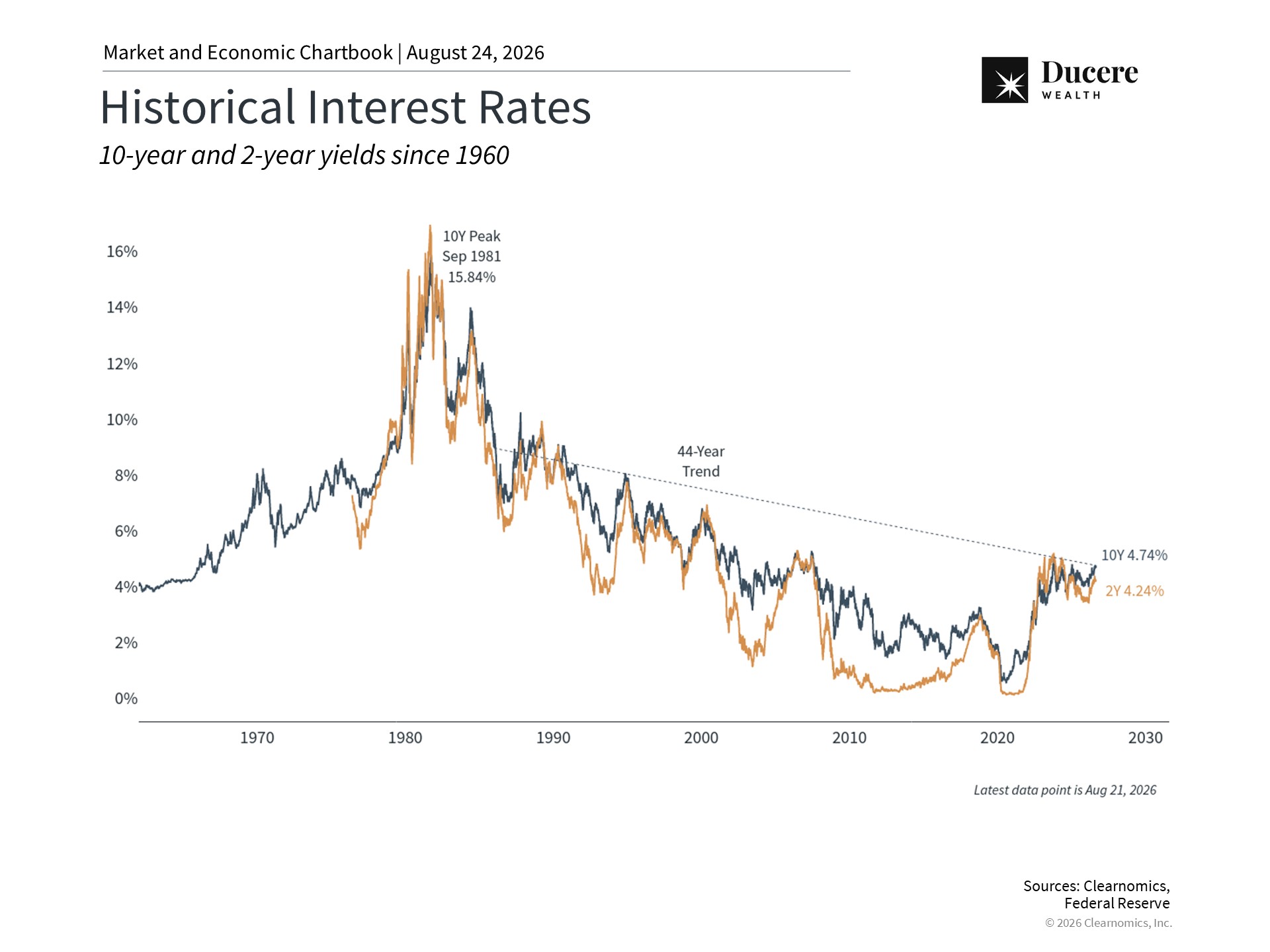
The 10-year Treasury yielded 4.74% as of August 21, 2026, with the 2-year at 4.24%. That is high relative to the post-2008 era, when the Federal Reserve held policy rates near zero for years and a 2% ten-year felt normal. It is not high by any longer standard. The 10-year peaked above 15% in September 1981. Rates today sit close to where they spent much of the 1960s.
The Treasury has been managing the long end where it can, increasing buyback operations and taking steps that discourage large foreign holders from selling. Those efforts are small against the size of the market.
For clients, the more useful takeaway isn’t directional. It’s that bonds do something now that they couldn’t for most of the last fifteen years. Meaningful income is available without stretching into credit risk or duration risk to find it. Whether that argues for a change in your allocation depends entirely on what the money is for and when you need it. That is a different question than what the ten-year did last week.
Staying aligned
Concerns about trade policy, the debt, and interest rates are likely to get louder as November approaches. That’s what election years do.
The distinction we’d hold onto: some of this requires a decision, and most of it doesn’t.
Requires a decision. A tariff refund landing in your business this year, with its tax treatment, timing, and knock-on effects on estimated payments and year-end planning. A meaningful cash balance sitting somewhere earning less than it could. An allocation set when rates were near zero that nobody has revisited since.
Doesn’t require a decision. The deficit number. The debt total. What the ten-year did this morning. These belong in the category of things worth understanding and not worth trading on.
If you’re expecting a refund and haven’t mapped out where it lands, in the business, in your tax picture, and in the broader plan, that’s a conversation worth having before December rather than after. We’re happy to be a second opinion on it, whether or not you’re a client.
Ducere Wealth Management, LLC is an SEC-registered investment adviser. Registration does not imply a certain level of skill or training. The content is for informational purposes only and should not be construed as personalized investment, tax, or legal advice. Advisory services are offered only through a written agreement with Ducere Wealth Management, LLC. All investments involve risk, including the potential loss of principal. Past performance does not guarantee future results.
Tax treatment of tariff refunds depends on individual facts and circumstances, including how the original duties were recorded. Consult your tax professional.
Sources
1. Learning Resources, Inc. v. Trump, No. 24-1287 (U.S. Feb. 20, 2026)
2. U.S. Customs and Border Protection, IEEPA duty refunds: https://www.cbp.gov/trade/programs-administration/trade-remedies/ieepa-duty-refunds
3. U.S. Treasury, Monthly Treasury Statement: https://fiscaldata.treasury.gov/datasets/monthly-treasury-statement/receipts-of-the-u-s-government
4. U.S. Treasury, Debt to the Penny: https://fiscaldata.treasury.gov/datasets/debt-to-the-penny
5. U.S. Treasury, National Deficit: https://fiscaldata.treasury.gov/americas-finance-guide/national-deficit
6. Congressional Budget Office, Monthly Budget Review (July 2026): https://www.cbo.gov/system/files/2026-08/61983-2026-07-MBR.pdf
7. U.S. Department of the Treasury press release: https://home.treasury.gov/news/press-releases/sb0607
8. Internal Revenue Code §111; 19 U.S.C. §1505