
First We Fear It. Then We Need It.

After a weekend that started with honoring the 25th anniversary of 9/11 and ended with the NFL season kickoff, what rattled markets to start the week was an essay from Anthropic CEO Dario Amodei imploring the world to slow down the pace of AI advancement.It is a novel idea in a world that seems to perpetually accelerate, and while the market initially had a shock, it eventually settled in with the rest of the noise that circulates the news cycle (oil, interest rates, etc.). This is not the first globally changing technology, but we think we have a responsibility to learn from the past and see how we can avoid the "shocks" and "crashes" ahead.
The wires that kept catching fire
In 1893, Chicago hosted the World's Columbian Exposition and introduced the American public to electric light at scale. More than 100,000 incandescent bulbs lit the fairgrounds. The facade of the Palace of Electricity, made of jute, kept catching fire.[4] Insurers were alarmed for good reason. One factory mutual reported electrical fires in 23 of the 65 New England mills it covered, and electricians were making up wiring rules as they went; by 1896 there were five separate and incompatible electrical codes circulating in the United States.[4]
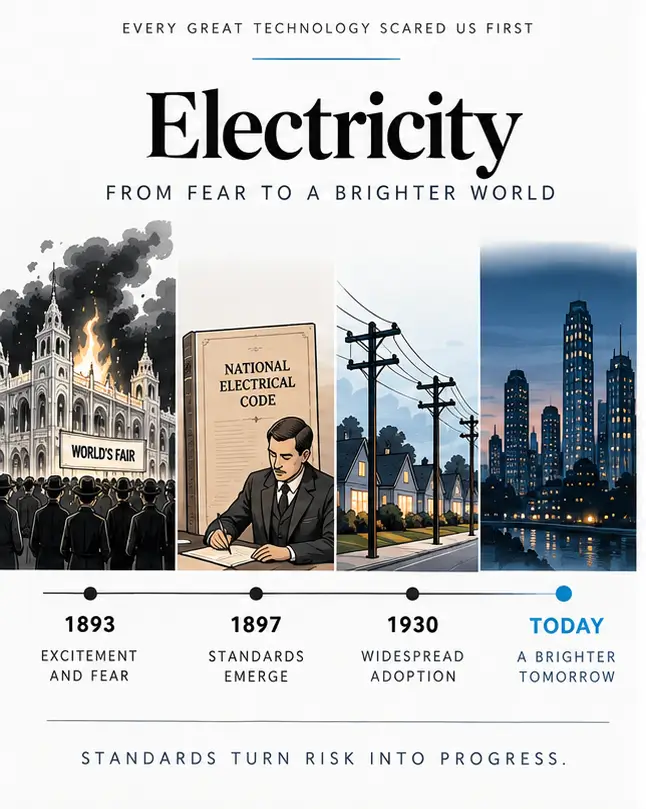
The response was not to abandon electricity. A 25-year-old inspector named William Merrill, sent by fire underwriters to assess the fair, stayed in Chicago and opened a testing lab above a fire patrol station with two employees and $350 of equipment. That lab became Underwriters Laboratories.[5] Three years later, in 1897, a coalition of insurers, engineers, architects and utilities published the first National Electrical Code.
[4][6] Standards, independent testing and a shared rulebook did not slow electrification. They made it possible for a bank to insure a building with wires in the walls, which is what allowed adoption to explode.
The car that killed 40,000 people a year
The automobile followed the same arc, at a much higher human cost.
In 1900 there were roughly 8,000 registered vehicles in the United States and 36 traffic deaths. By 1913 there were 1.26 million vehicles and 4,079 deaths. By 1937, with 30 million cars on the road, the country was losing 37,819 people a year to crashes. The death rate per 100 million miles driven in 1921 was 24.08.[7]
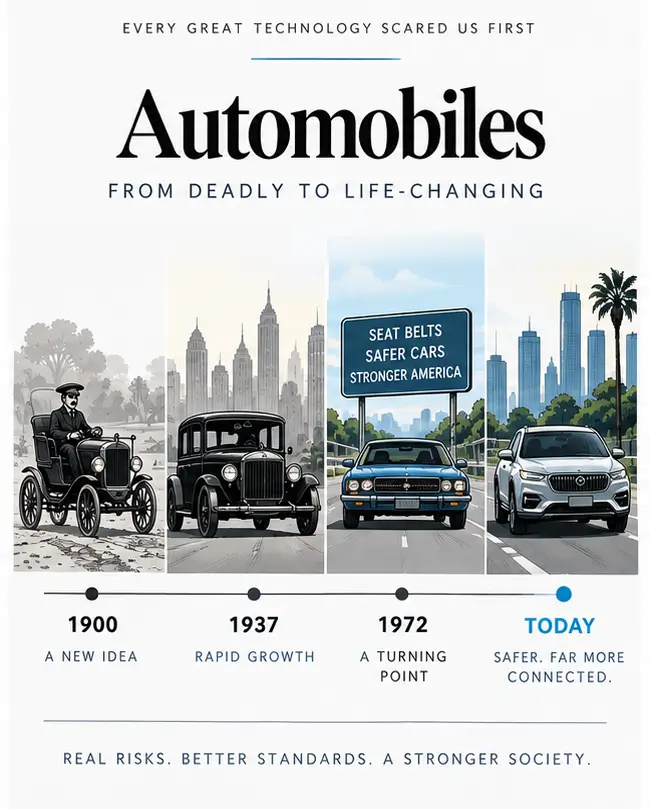
For most of that period, the rules were thin. Before 1966 the federal government regulated brake fluid quality, lap belts for front outboard seats, and little else.[8] On September 9, 1966, President Johnson signed two laws, the National Traffic and Motor Vehicle Safety Act (P.L. 89-563) and the Highway Safety Act (P.L. 89-564), which for the first time gave the federal government authority to set mandatory safety standards for every car sold in the United States. The agencies those laws created were consolidated in 1970 into the National Highway Traffic Safety Administration.
[14] Seat belts became mandatory equipment in new cars in 1968. New York passed the first law requiring people to actually wear them in 1984, over loud objections that it infringed on personal freedom.[9] By 1998 NHTSA estimated belts alone were saving at least 10,000 lives a year.[10] The results are the clearest case study in technology regulation we know of. Total traffic deaths peaked at 55,600 in 1972. In 2023, Americans drove 3.25 trillion miles, nearly 60 times the 1921 total, and 40,901 people died. The fatality rate fell from 24.08 per 100 million miles to 1.26, a decline of roughly 95%.[7] NHTSA's early estimate for 2025 is 1.10, the second-lowest rate ever recorded.
[11] And we are more dependent on the car than on almost anything else we own. There are 284.6 million registered vehicles and 237.7 million licensed drivers in this country.[7] The rules did not shrink the technology. They let it become the backbone of the economy.
We measure risk with our gut, not with data
Here is the part that matters for AI.
Even after a century of safety engineering, driving is still one of the most dangerous things most Americans do. Unintentional injury is the third leading cause of death in the United States. Motor vehicle crashes killed 41,241 people in 2024, about 12 per 100,000 population, and they are the single leading cause of injury death for every age group from 5 to 24.[12][13]
Now ask yourself how many people you know who have looked at that number and decided not to drive. Not many. We buckle up, we trust the airbags, and we merge onto the freeway at 70 miles per hour without a second thought, because the rules and the engineering have made the risk feel manageable, and because the alternative, giving up mobility, is unthinkable.
That is how humans actually measure risk. We do not weigh probabilities. We weigh familiarity, control and how much we would lose by opting out. Electricity felt terrifying in 1893 and invisible by 1930. Cars felt reckless in 1920 and unremarkable by 1960. Each time, the danger was real, the early rules were crude, and adoption ran far ahead of the safeguards until institutions caught up.
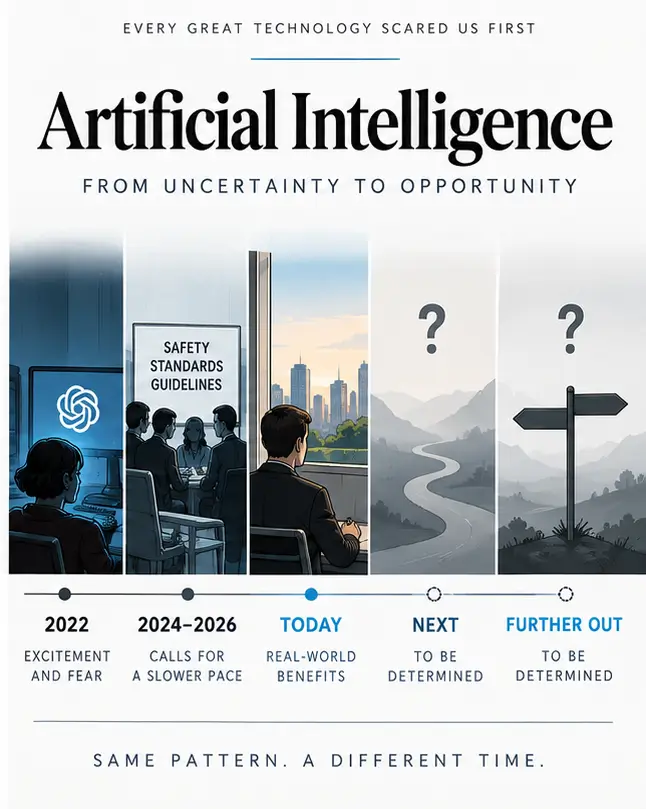
AI is at the 1893 World's Fair stage. The wires are sparking, the insurers are nervous, and the people building the technology are asking for testing labs and a shared code. If history is any guide, that is not the moment the technology stalls. It is the moment it becomes permanent.
What we have seen inside our own firm
We can speak to this from experience, not theory. We adopted AI early at Ducere, and we did it with our eyes open. These tools make mistakes. They can state a wrong number with total confidence, and they do not know a client's family the way we do. So we built our workflows around that reality: a person reviews every output, the tools never touch client accounts directly, and the judgment calls stay with us.
With those guardrails in place, the results have been remarkable. Work that used to consume a full day, reconciling a prospect's tax return against their portfolio, pulling a household's holdings into a transition analysis, drafting the first version of a planning memo, now takes a fraction of the time. Information that once lived in six places and three formats can be organized into something coherent in minutes rather than hours. We are still early in this. We are a young firm and we are learning what these tools are good at and where they fall short. But the improvement in the day-to-day work we do for clients is not incremental. It is the largest change in how we operate that any of us has experienced.
That is also why we take Amodei's essay seriously rather than dismissing it as a marketing exercise. The people asking for a slower pace are not skeptics. They are the ones who see the most.
Ducere Wealth Management, LLC is an SEC-registered investment adviser. Registration does not imply a certain level of skill or training. The content is for informational purposes only and should not be construed as personalized investment, tax, or legal advice. Advisory services are offered only through a written agreement with Ducere Wealth Management, LLC. All investments involve risk, including the potential loss of principal. Past performance does not guarantee future results.
Sources:
- Dario Amodei, "We Must Pace the Frontier," September 2026.
- TheStreet, "Stock Market Today (Sept. 14, 2026)."
- CNN Business, "AI stocks slide after top industry CEOs call for slowdown," September 14, 2026.
- Electrical Contractor Magazine, "125 and Counting: Important History Behind Establishment of NEC."
- UL Research Institutes, "Our History."
- National Board of Fire Underwriters, National Electrical Code, First Edition, 1897 (Internet Archive). NFPA became sponsor in 1911.
- Federal Highway Administration, Table FI-200, "Motor Vehicle Traffic Fatalities, 1900–2023," April 2025.
- SAGE Encyclopedia of Business Ethics and Society, "National Traffic and Motor Vehicle Safety Act."
- New York State Police, "Seat Belt Law Begins" (1984).
- Encyclopaedia Britannica, "National Highway Traffic Safety Administration."
- NHTSA, "Early Estimate of Motor Vehicle Traffic Fatalities in 2025," DOT HS 813 800.
- CDC National Center for Health Statistics, FastStats: Accidents or Unintentional Injuries (2024 mortality data).
- CDC WISQARS, "10 Leading Causes of Injury Deaths by Age Group, United States, 2024."
- Congressional Research Service, "NHTSA's Authorities and Rulemaking Process," IF13178, updated June 30, 2026.