
Midterm Fright: Unmasking the Market's Election-Season Monsters
Every Episode Ends the Same Way
One of my favorite shows growing up was Scooby-Doo. I loved the characters and the storylines, but what really hooked me was the build-up. Every kid watching knew how it would end. The monster was never actually a monster; it was the groundskeeper or the shady developer in a rubber mask, and he would have gotten away with it, too, if it weren't for those meddling kids.
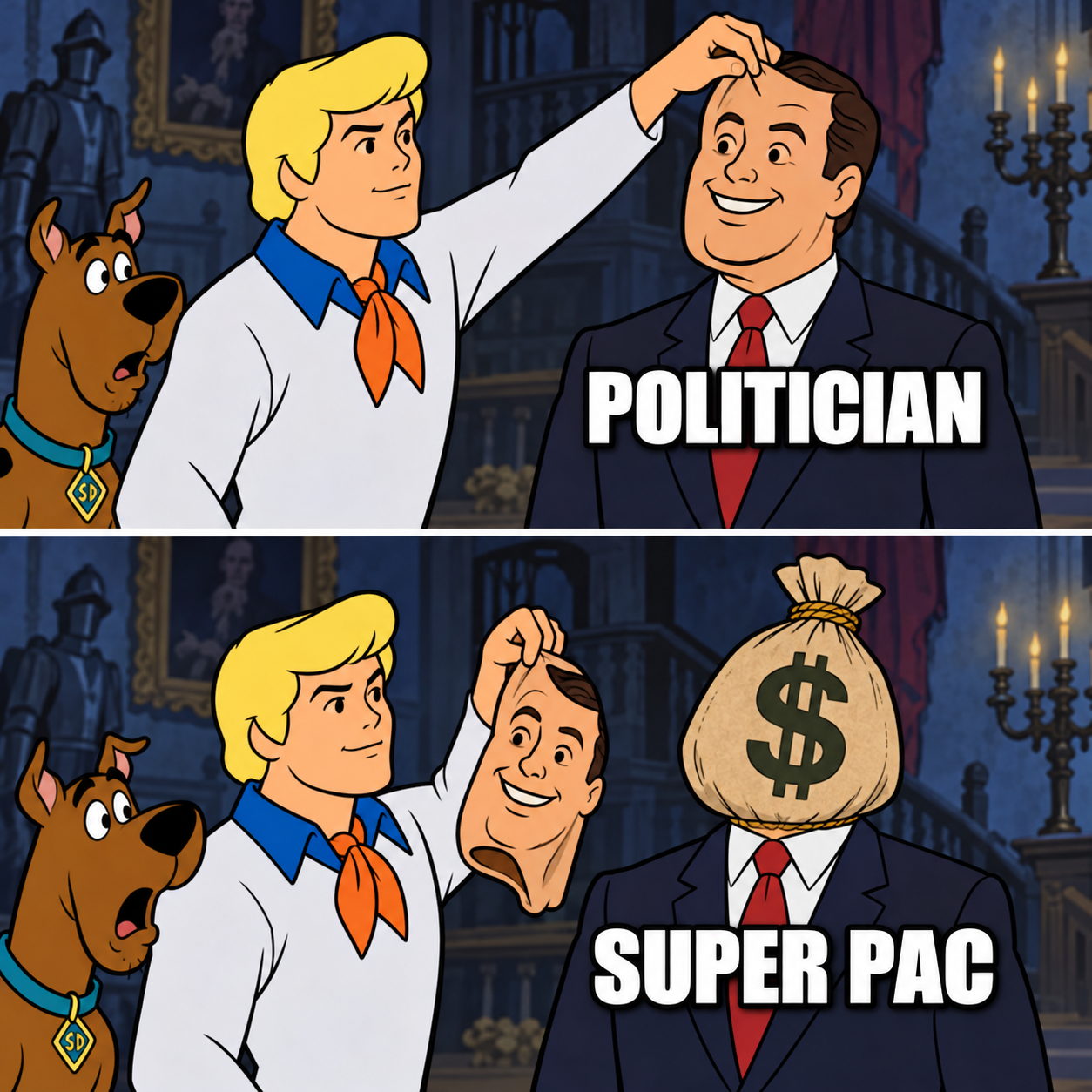
Turn on the TV this October and you would think the ballot is a haunted house. Nearly every candidate, on both sides of the aisle, is painted as a ghoul. Yet when you pull off the mask, the villain looks familiar: a small number of super PACs and outside groups paying for a large share of the noise. AdImpact projects a record $11.6 billion in political ad spending this cycle, and TIME reports that a large portion of it comes from a handful of wealthy donors bankrolling super PACs on the left and the right.
Politics, Money, and the Dinner Table
Politics, like finance, is deeply personal, no matter where you sit on the spectrum. That is why etiquette guides going back to the 1800s have steered polite company away from politics and religion, with money often added as a third forbidden topic. My favorite version came from a 1961 Peanuts strip, when Linus listed the three things he never discusses: religion, politics, and the Great Pumpkin. Fitting for October.
So I am going to break the rule, at least on the page.
Why Markets Shrug at Midterms
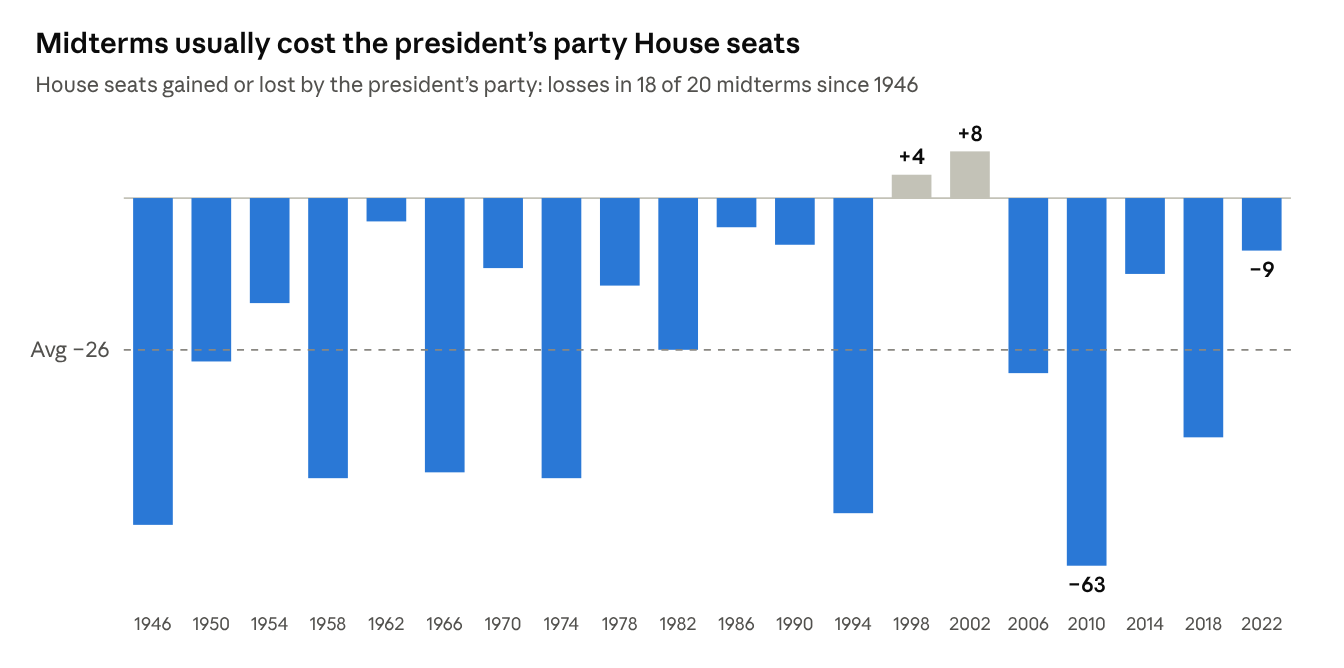
For all the excitement politics bring, the market's reaction to midterms has historically been uneventful. Like most of us, the market likes predictability, and few things are as predictable as a divided government. Ken Fisher points out that the president's party has lost House seats in 89% of midterms and Senate seats in 71%. Once power splits, very little gets passed, and Washington settles into a light hum until the next presidential election.
That does not mean the noise stops. The next federal budget deadline lands on December 11, just weeks after Election Day. A debt-ceiling fight or even a shutdown is on the table. Yet as the Clearnomics chart below shows, markets have looked past shutdowns quickly, because earnings, interest rates, and economic growth do the heavy lifting over time.
My Three Not-So-Frightening Predictions
1. Democrats win the House, and the Senate stays split
The House looks all but settled; Kalshi prediction-market traders put Democrats’ odds of taking it at 92%. The Senate is a closer call; traders price Democrats at 68% there, but I expect it to land near an even split, which keeps either party from pushing through a sweeping agenda.
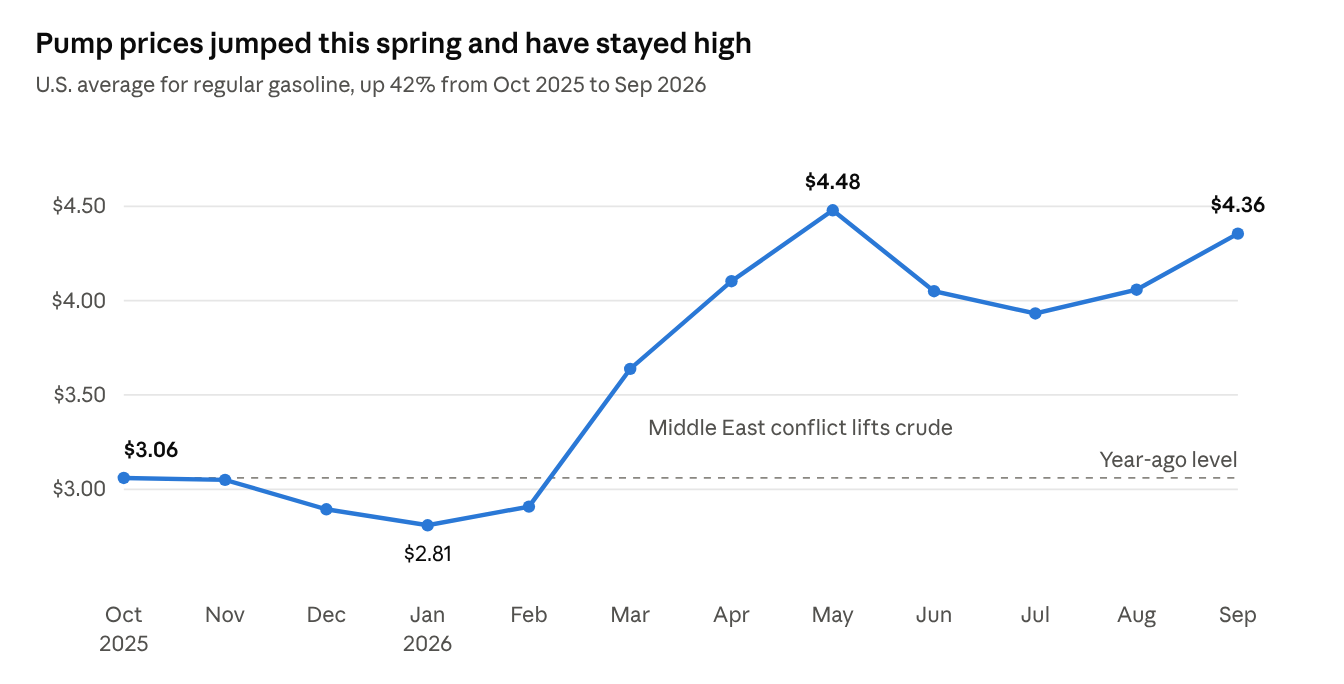
Why the shift? Elections tend to come down to the experience at the pump. A year ago, a gallon of regular cost about $3.06. After conflict in the Middle East pushed crude toward $100 a barrel, the national average climbed past $4.40 by May, and September set a record for the month. Even after the switch to cheaper winter-blend fuel, AAA's national average was still $4.27 this week. Voters feel that every time they fill up, and the party in the White House usually wears it.
2. Data center advocates rise from the grave
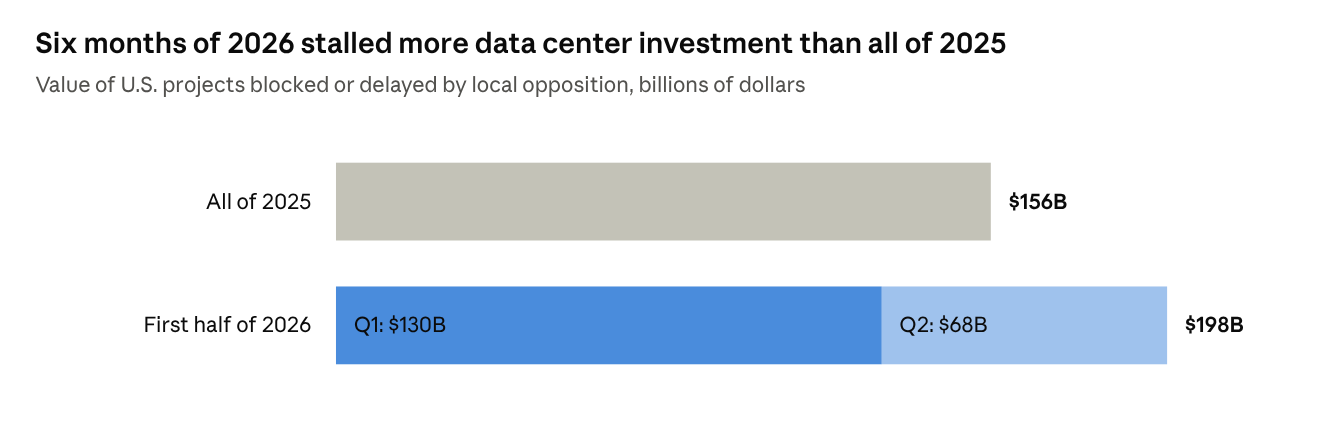
Data centers became one of the few truly bipartisan issues of 2026, as voters connected rising electric bills to the AI build-out. CBS reports that opposition outweighs support by 30 points, and campaigns have spent $45 million on ads mentioning data centers, most of them against. Candidates in both parties ran from the projects, Texas paused new permits and grid connections, and Data Center Watch counted about $198 billion of projects blocked or delayed by local opposition in the first half of 2026 alone, more than in all of 2025.
My prediction is that data center advocates come back to life after November 3. The economics never died: the largest cloud companies are on pace to spend more than $600 billion on capital projects this year, mostly on data centers. Once the ballots are counted, the debate shifts from "not here" to "on what terms," with developers covering their own power and grid costs. Delayed is not the same as cancelled.
3. The market ends the year higher than it closes on November 4
My third prediction is the least frightening: the S&P 500 finishes 2026 above its close on November 4, the day after the election. History is on our side. Schaeffer's Investment Research found that across midterms from 1950 through 2018, the S&P 500 gained an average of 2.69% from Election Day to year-end and rose 67% of the time.
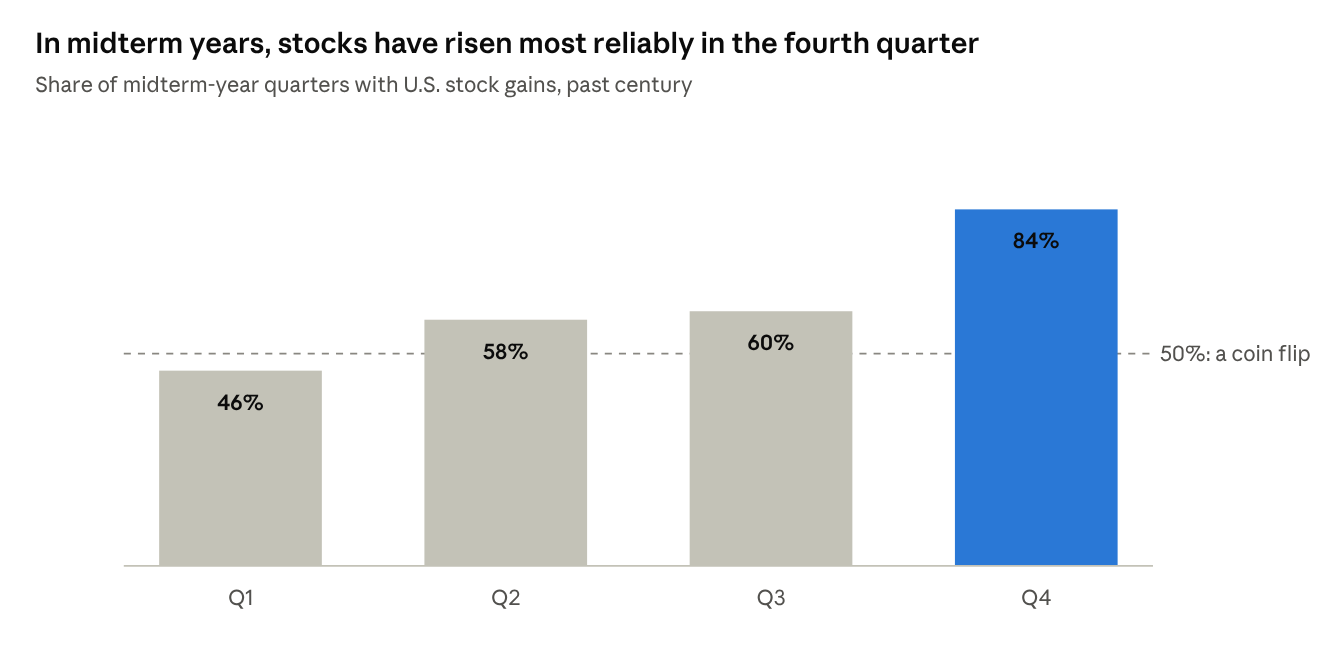
Ken Fisher's research, published this month, shows how a midterm year tends to unfold. Stocks have risen in only 46%, 58%, and 60% of first, second, and third quarters, then in 84% of fourth quarters. Over the nine months after the vote, they have risen 92% of the time. Fisher calls it the midterm miracle. I call it the treat at the end of the haunted house.
Trick or Treat?
Every Scooby-Doo episode ends the same way: the mask comes off, and the monster turns out to be someone ordinary. Midterms tend to end the same way, too. The ads go dark, gridlock sets in, and the market gets back to what actually drives it: earnings, interest rates, and economic growth.
For our clients, that means the plan stays the plan. If the headlines are keeping you up at night, give us a call and we will walk through your portfolio together. That is the treat. The trick is letting the monsters make your decisions for you.
Sources:
- AdImpact projection via TIME, Midterm Ad Spending Has Surpassed $10B, Oct 19, 2026
- Etiquette-rule history: Barry Popik, Never talk about religion or politics
- Clearnomics, What the Midterm Election, Budget Deficit, and National Debt Mean for Investors, Oct 26, 2026 (budget deadline and shutdown chart)
- Ken Fisher, The stock markets will celebrate the mid-term elections, Il Sole 24 Ore, Oct 18, 2026
- Kalshi, Who will control the House? and Who will control the Senate? markets, as of Oct 30, 2026
- EIA regular gasoline price, monthly, via FRED (GASREGM)
- AAA: National Average Dips Following Record-Setting September and AAA October 2026 updates
- CBS News, Data center boom puts Republicans in a bind, Oct 12, 2026
- Data Center Watch: Q3 to Q4 2025, Q1 2026, Q2 2026
- LPL Research, Hyperscalers Plan to Live Up to Their Name
- Schaeffer's Investment Research, What Election Day Means for the S&P 500, Oct 26, 2022
- The American Presidency Project, Seats in Congress Gained/Lost by the President's Party in Mid-Term Elections, UC Santa Barbara, updated July 13, 2026
Ducere Wealth Management, LLC is an SEC-registered investment adviser. Registration does not imply a certain level of skill or training. This article is for informational purposes only and is not investment, tax, or legal advice. The views expressed are the author's as of the date of publication and are subject to change. Predictions and forecasts are not guarantees of future results, and past performance does not guarantee future results. Indices are unmanaged and cannot be invested in directly. Third-party data is believed to be reliable but is not guaranteed. Ducere does not endorse any political party or candidate.